
South Dakota DPS Permit Practice Test 1
Test 1 of 10. Pick an answer for each question to see if it is right and why; your score appears at the end. You need 20 correct answers to pass, the same ratio as the real South Dakota test.
- Questions25
- Correct to pass20
- Passing score80%
- Minimum age14 years
-
1. A South Dakota minor who has not completed an approved driver education course must hold an instruction permit for how long before applying for a restricted minor's permit?
Show answer
Answer C: 275 days
For permits issued after July 1, 2020 the holding period is 275 days, which drops to 180 continuous days when an approved driver education course is completed.
-
2. You are driving in fog so thick that you can barely see the vehicle ahead. Which pavement marking is the best guide for staying in your lane?
Show answer
Answer A: The white edge line on the right side of the road
The right edge line keeps you positioned away from oncoming traffic and is easy to follow at low speed. Following tail lights closely tempts you to drive faster than you can see.
-
3. Where is the safest place for children under 13 to ride?
Show answer
Answer C: In the back seat
The back seat keeps children away from the force of a deploying front air bag and is farther from the most common impact area, which is why it is recommended through at least age 12.
-
4. On a South Dakota two-lane highway, how must you react to a vehicle stopped on the shoulder using amber, yellow or blue warning lights?
Show answer
Answer A: Slow to at least 20 miles per hour below the posted limit starting 300 feet before the vehicle
Where changing lanes is not possible, drivers must slow to at least 20 miles per hour under the posted limit at least 300 feet before the vehicle and proceed with caution.
-
5. A person with a guide dog is standing at the corner facing the street you are about to cross. What should you do?
Show answer
Answer D: Stop well back and wait quietly for them to decide
Blind pedestrians rely on engine sound to judge traffic, so stop back from the crossing and avoid the horn, which only confuses them.
-
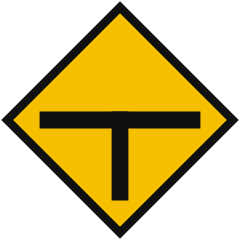
6. On which approach is this sign normally installed?
Show answer
Answer C: On the road that ends, far enough ahead for the driver to slow down
The warning belongs on the approach that terminates, placed early enough that the driver can lose speed and choose a direction before reaching the junction.
-
7. How must a South Dakota law enforcement officer enforce the wireless communication device ban that applies to instruction permit and restricted minor's permit holders?
Show answer
Answer A: As a secondary action, only after the vehicle has already been stopped for another reason
State law requires this violation to be enforced as a secondary action, meaning an officer cannot stop the permit holder for that violation alone.
-
8. How closely may a South Dakota driver follow fire apparatus responding to an alarm?
Show answer
Answer C: No closer than 500 feet
State law prohibits following fire apparatus responding to a fire alarm any closer than 500 feet.
-
9. The brake pedal goes to the floor and the vehicle does not slow. What should you try first?
Show answer
Answer C: Pump the pedal quickly to try to build pressure
Most vehicles have a split braking system, so rapid pumping can often build enough pressure to slow you. If it does not, use the parking brake gradually.
-
10. What alcohol level makes it an offense for a South Dakota driver under 21 to be in control of a vehicle?
Show answer
Answer A: 0.02 percent or more
South Dakota's zero tolerance rule makes it a Class 2 misdemeanor for a driver under 21 to drive with physical evidence of 0.02 percent or more alcohol.
-
11. You stop behind another vehicle at a traffic light. How much space should you leave?
Show answer
Answer D: Enough to see where its rear tires touch the pavement
Seeing the rear tires on the road leaves room to steer around the vehicle if it stalls, and gives a cushion if you are struck from behind.
-
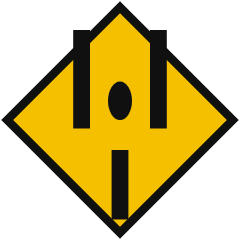
12. Beyond the point this sign refers to, which movement becomes unlawful?
Show answer
Answer D: Driving on the far side of the separation, against the flow
Once the two directions are separated, each roadway carries one-way traffic, so crossing to the other side means driving into oncoming vehicles.
-
13. A bicyclist ahead of you extends the left arm out with the forearm bent upward. What does that signal mean?
Show answer
Answer A: The bicyclist intends to turn right
Bicyclists use the same hand signals as drivers: left arm straight out means left, left arm bent up means right, and left arm bent down means stop or slow.
-
14. What is the classification of the offense for failing to maintain financial responsibility on a South Dakota vehicle?
Show answer
Answer B: A Class 2 misdemeanor
Failing to maintain one of the approved forms of financial responsibility is a Class 2 misdemeanor under state law.
-
15. Your light turns green, but a vehicle from the cross street is still finishing a turn inside the intersection. What should you do?
Show answer
Answer B: Wait until that vehicle has cleared the intersection
A green indication lets you proceed only after yielding to pedestrians in the crosswalk and to vehicles already lawfully within the intersection.
-
16. Which circumstance can make a South Dakota court condition a DUI defendant's driving permit on participation in the 24/7 sobriety program?
Show answer
Answer C: The defendant had a blood alcohol concentration of 0.17 percent or more, or a prior DUI conviction within the last ten years
The 24/7 sobriety program condition applies when the defendant had a very high 0.17 percent or greater BAC, or has a prior DUI conviction within the past decade.
-
17. Who has the authority to set the maximum speed for heavy vehicles, such as those over 10,000 pounds gross weight, on South Dakota highways?
Show answer
Answer C: The Transportation Commission, through adopted rules
State law directs the Transportation Commission to adopt rules setting the maximum speed for heavy vehicles rather than fixing a single number in the statute itself.
-
18. Does using a hands free device remove the risk of distraction?
Show answer
Answer A: No, the conversation still takes attention away from driving
Hands free equipment removes the manual part of the distraction but not the mental part, and a driver deep in conversation can look straight at a hazard without registering it.
-
19. You are making a U-turn at a signal on a green left arrow. Who must you still watch for?
Show answer
Answer D: People in the crosswalk you will cross as you come around
Even a protected arrow does not clear the crosswalk, and a U-turn sweeps across a crosswalk that pedestrians may already be using.
-
20. A law enforcement officer is directing traffic and waves you forward while the signal facing you shows red. What should you do?
Show answer
Answer A: Follow the officer's direction and proceed
Directions given by an officer controlling traffic take priority over signals, signs and pavement markings.
-
21. What exception applies to the weight limit on vehicles a South Dakota restricted minor's permit holder may operate?
Show answer
Answer C: Self-propelled agricultural machinery not subject to registration is exempt from the weight limit
The weight restriction does not apply when the permit holder is operating a self-propelled agricultural machine that is not subject to vehicle registration.
-
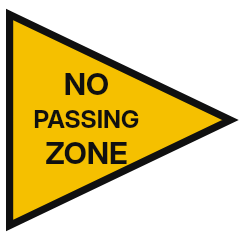
22. A driver is thinking about overtaking a slower vehicle and sees this sign a short distance ahead. What does it mean for that pass?
Show answer
Answer B: The pass must be finished before the restricted section begins
The sign marks the start of a section where passing is prohibited, so a driver may not be on the left side of the road beyond it; any pass has to be completed before that point or not started at all.
-
23. How many points in any 12 consecutive months make a South Dakota driver subject to suspension?
Show answer
Answer C: 15 points
South Dakota uses a threshold of 15 points in any 12 consecutive months, or 22 points in any 24 consecutive months.
-
24. A bicyclist stops at a four-way stop just before you do. Who goes first?
Show answer
Answer B: The bicyclist, who reached the intersection and stopped there before you did
A bicyclist on the roadway follows the same right of way rules as a driver, so arrival order decides the turn.
-
25. What is the minimum lawful speed on South Dakota's interstate highways, absent a special permit?
Show answer
Answer B: 40 miles per hour
Driving an interstate highway below 40 miles per hour is a Class 2 misdemeanor unless the vehicle operates under a department-issued permit.