
South Dakota DPS Permit Practice Test 8
- Questions25
- Correct to pass20
- Passing score80%
- Minimum age14 years
-
1. Traffic is heavy and crawling where a sign warns that your lane ends and two lanes must become one. What is the best practice?
Show answer
Answer C: Use the lane to the end, then take turns merging one by one
In stop-and-go traffic the zipper merge, using both lanes up to the merge point and then alternating, keeps the queue shorter and traffic moving; in free-flowing traffic move over as soon as it is safe.
-
2. No plaque stating days or hours accompanies this sign at the intersection. When does the restriction apply?
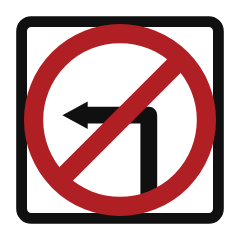
Show answer
Answer D: At all times, since nothing limits it to particular periods
A regulatory restriction runs continuously unless a supplemental plaque states the days or hours during which it applies.
-
3. What does a sign reading Slower Traffic Keep Right require?
Show answer
Answer C: Traffic moving slower than the general flow must use the right-hand lane
The sign applies to any vehicle traveling below the speed of the traffic around it, which must keep right so faster vehicles can use the lanes to the left.
-
4. At which location is this sign normally installed?

Show answer
Answer D: Facing traffic that could turn into a one-way roadway or ramp against the flow
It is posted where a driver could otherwise enter a ramp or a one-way roadway from the wrong end, so it faces exactly the traffic that has to be kept out.
-
5. You are backing out of a space in a parking lot. Who has the right of way?
Show answer
Answer D: Traffic already moving in the lane, and pedestrians walking behind you
A driver backing out must yield to vehicles and pedestrians already using the lane, because backing is the movement with the poorest view.
-
6. You come upon a person riding a horse on the roadway ahead of you. What is the correct way to pass?
Show answer
Answer A: Slow down, give plenty of room and do not use the horn
Horses startle easily, and a frightened horse can throw its rider into your path. Pass slowly and wide, and avoid any sudden noise.
-
7. The lights at a highway-rail grade crossing begin to flash red as you approach. What must you do?
Show answer
Answer B: Stop short of the tracks and wait until the lights stop and no train is near
Flashing red lights at a crossing require a stop clear of the tracks, and you may proceed only once the lights have stopped, any gates are fully raised and no train is approaching.
-
8. A sign with a blue background and a white legend and border tells road users about
Show answer
Answer A: services such as fuel, food, lodging, hospitals and rest areas
Blue is the background of the general service series, which points travelers toward the services available along or near the route.
-
9. About how far does a vehicle travel in one second at 60 mph?
Show answer
Answer A: About 88 feet
At 60 mph you cover about 88 feet every second, which is why a glance of only two or three seconds means driving the length of several vehicles blind.
-
10. Where is this sign installed in relation to the hazard it announces?
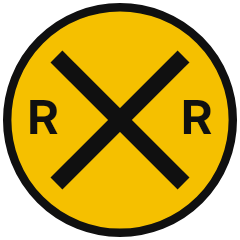
Show answer
Answer A: Far enough before the hazard that a driver can slow down and stop short of it
This is an advance warning sign, placed on the approach so a driver has time to react before reaching a crossing that a curve or a crest may be hiding.
-
11. Your headlights suddenly go out while you are driving at night. What should you do?
Show answer
Answer A: Try the dimmer switch and the headlight switch, turn on the hazard lights and pull off the road
Switching between high and low beams or cycling the light switch sometimes restores the lights. If not, use the hazard and parking lights to get off the road safely.
-
12. A yellow diamond shows a car with wavy lines behind its rear tires. What is the warning?
Show answer
Answer D: The surface loses grip badly when it is wet
The slippery when wet sign marks a stretch where traction falls off sharply in rain, so speed and braking must be reduced well in advance.
-
13. A driver reaching a stop sign is required to do what?
Show answer
Answer D: Come to a complete stop and then proceed only when it is safe
A stop sign requires a full stop before the stop line, crosswalk or intersection, after which the driver may go on once the way is clear.
-
14. What is true about driving away from a crash you were involved in?
Show answer
Answer B: It is a serious offense, even if the other driver has driven away too
Leaving the scene is a criminal offense in every state, and the behavior of the other driver does not excuse it.
-
15. Your steering suddenly feels light and unresponsive as you drive through standing water. What should you do first?
Show answer
Answer A: Ease off the accelerator and keep the steering wheel pointed straight
Those symptoms mean the tires are riding on a film of water, and gently lifting off the accelerator lets them settle back onto the pavement. Hard braking or sudden steering while hydroplaning can start a skid.
-
16. You are waiting to pull out of a driveway when a bicyclist comes along the bike lane in front of you. What must you do?
Show answer
Answer D: Wait until the bicyclist has gone past
A driver leaving a driveway yields to everything already on the road, and a bike lane is part of the roadway.
-
17. Why is a sign reading BRIDGE ICES BEFORE ROAD worth heeding even when the road itself is merely wet?
Show answer
Answer C: Cold air passes under a bridge as well as over it
A bridge deck loses heat from below as well as above, so it can be frozen while the road on either side of it is only wet.
-
18. A school sign combined with an AHEAD plaque, or with a plaque giving a distance in feet, forms an assembly that
Show answer
Answer B: warns of a school crossing located further along the road
The school advance crossing assembly is placed before the crosswalk to give drivers notice, while a different assembly marks the crossing itself.
-
19. Why is it dangerous to make a left turn from the second lane from the center?
Show answer
Answer C: Because a driver in the lane beside you is turning into the same space
Drivers in the proper turn lane are entitled to that space, and turning across them puts two vehicles into one path through the intersection.
-
20. A traffic signal is dark and you reach the intersection at the same moment as a vehicle on your right. Who goes first?
Show answer
Answer A: The vehicle on your right, as at any all-way stop
A dark signal is treated as an all-way stop, and the usual tie-breaker then applies: the vehicle on the right goes first.
-
21. An entrance ramp joins a highway just before an exit ramp leaves it. What should you expect in that short section?
Show answer
Answer D: Vehicles crossing paths as some enter and others leave
In a weaving section entering traffic moves left while exiting traffic moves right over the same short stretch, so lane changes there need extra room and extra care.
-
22. A large panel mounted on a trailer at the roadside displays a flashing arrow pointing left. What does it tell you?
Show answer
Answer B: Move into the lane to your left
An arrow panel directs traffic out of a closed lane, so the arrow shows the direction you must move rather than the shape of the road ahead.
-
23. If a South Dakota driver is convicted of driving while their license is already suspended, what happens to the suspension period?
Show answer
Answer B: It is extended for an additional period equal to the original suspension
A conviction for driving while suspended causes the department to extend the suspension by another period of the same length.
-
24. Traffic is heavy and a truck is stopped in the lane on your right. How do you keep an out?
Show answer
Answer B: Keep space open ahead of you and avoid being boxed in on both sides at once
Being hemmed in on both sides with no gap ahead removes every option, so keep at least one direction open.
-
25. Why are pedestrians and cyclists a special risk on unlit streets at night?
Show answer
Answer A: Dark clothing can make them invisible until they are very close
A person in dark clothing reflects almost no light and may not appear until they are inside your stopping distance, so cut your speed where people may be about.