
South Dakota DPS Permit Practice Test 2
- Questions25
- Correct to pass20
- Passing score80%
- Minimum age14 years
-
1. The left-turn signal facing you shows a flashing yellow arrow. What does it mean?
Show answer
Answer C: You may turn left after yielding to oncoming traffic and to pedestrians
A flashing yellow arrow permits a left turn but gives no protection, so you must yield to oncoming vehicles and to people in the crosswalk.
-
2. You are entering a freeway using an on-ramp with an acceleration lane. What is the correct technique?
Show answer
Answer C: Use the acceleration lane to reach the speed of traffic, then merge into a gap while yielding to traffic already on the freeway
The acceleration lane exists so you can match the speed of freeway traffic before merging, and drivers already on the freeway have the right-of-way.
-
3. You pull onto a soft grass verge to park. What is the main risk?
Show answer
Answer A: The wheels can sink and the car can slide toward the ditch
Soft ground gives way under the weight of a vehicle, and a car that settles or slides sideways can end up stuck or in the ditch.
-
4. Which ability does alcohol usually affect first?
Show answer
Answer A: Judgment and self control
Alcohol reduces judgment and inhibition before a drinker notices any clumsiness, which is why an impaired driver often feels perfectly capable while already driving worse.
-
5. Is it safe to check your phone while stopped at a red light?
Show answer
Answer B: No, you may miss the signal change and hazards around you
Attention does not return instantly when the light changes, and emergency vehicles, pedestrians or a rear-end threat can appear while you are stopped. Stay focused on the road.
-
6. A row of solid white triangles points toward you across your lane. What does it mark?
Show answer
Answer A: The place to yield to traffic or people ahead
A yield line of triangles shows drivers exactly where to give way, and it is used at roundabouts and at midblock crosswalks.
-
7. You are parked legally, but a police officer tells you to move the vehicle. What should you do?
Show answer
Answer B: Move it as directed, because an officer overrides the signs
Directions from a police officer or a firefighter take precedence over signs and markings, whether they are directing traffic or clearing a street.
-
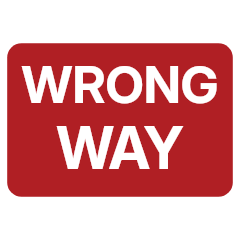
8. This sign comes into view ahead of a driver who has already started along a ramp. What should the driver do?
Show answer
Answer B: Pull clear where it is safe, then turn around and leave the ramp traveling properly
The driver is traveling against the legal flow, so the safest response is to stop clear of the lanes, turn the vehicle around and get off the ramp before meeting traffic head on.
-
9. You have just passed a large truck on the freeway. Why is it dangerous to pull back in front of it and then brake for your exit?
Show answer
Answer B: A loaded truck needs much more distance to stop than a car
A fully loaded tractor-trailer can need the length of a football field or more to stop from highway speed. Cutting in and braking leaves the driver no room to avoid hitting you.
-
10. You are waiting to turn and the traffic ahead has stopped. Where must you not come to rest?
Show answer
Answer D: On the crosswalk, which people need in order to cross the street
Stopping on a crosswalk forces pedestrians out into the traffic lanes to get around you, so you hold back before it instead.
-
11. You are traveling at 55 mph on a rural road and come up behind a horse-drawn buggy. What is the main danger?
Show answer
Answer D: You close on it very quickly because it moves at walking pace
A buggy travels only a few miles an hour, so the gap closes far faster than drivers expect and there is very little time to brake once you see it.
-
12. Which sign tells you that the vehicles ahead are part of a funeral procession?
Show answer
Answer C: Headlights burning in daylight, with small flags or markers on the vehicles
Processions are normally identified by daytime headlights, hazard lights and flags or windshield markers, not by emergency lights or sirens.
-
13. You are turning left from a two-way street onto a one-way street. Which lane should you enter?
Show answer
Answer C: The first lane open to traffic on the left side of the one-way street
Turn left from the lane closest to the center line and finish in the first available lane on the left of the one-way street, then change lanes if you need to.
-
14. What is the purpose of a wide solid white line painted straight across your lane on the approach to an intersection?
Show answer
Answer C: It shows the point where a required stop must be made
A stop line indicates the point at which the stop required by a signal or a stop sign is to be made, ahead of the crosswalk and the intersection.
-
15. What is the benefit of looking far down the road rather than just ahead of the hood?
Show answer
Answer A: You steer with smaller corrections and you see trouble in plenty of time
A distant view steadies your steering and gives you time to plan, because you meet hazards after you have already seen them.
-
16. Which sequence describes a well-made turn?
Show answer
Answer A: Signal, move into the correct lane, slow down, check, then turn
Tell others first, take your position, lose the speed before the corner, take a final look, and only then steer through the turn.
-
17. You hear a bang and one of the front tires deflates while you are on the highway. What happens to the vehicle?
Show answer
Answer D: It pulls strongly toward the side that failed
The collapsed tire drags heavily on that corner, so the vehicle veers toward it. Hold the wheel firmly, keep your line and let the speed fall before leaving the road.
-
18. Where is the no passing zone pennant sign installed?
Show answer
Answer A: On the left side of the roadway
The pennant is placed on the left side of the roadway at the beginning of the no-passing zone, in the field of view of a driver who is thinking about overtaking.
-
19. How does a wet road change the distance you need to stop?
Show answer
Answer C: It lengthens it, so you need a much bigger gap ahead
Water between the tire and the road cuts grip, so braking distance grows and the gap that works on dry pavement is no longer enough.
-
20. Why is texting considered one of the most dangerous distractions?
Show answer
Answer B: It combines visual, manual and cognitive distraction at the same time
Reading or writing a message takes your eyes off the road, at least one hand off the controls and your attention off driving simultaneously.
-
21. A bicyclist ahead of you extends the left arm out with the forearm bent upward. What does that signal mean?
Show answer
Answer A: The bicyclist intends to turn right
Bicyclists use the same hand signals as drivers: left arm straight out means left, left arm bent up means right, and left arm bent down means stop or slow.
-
22. You hold steady pressure on the brake pedal for the whole of a long descent. What is likely to happen?
Show answer
Answer B: The brakes overheat and fade, so they slow you less and less
Continuous braking heats the brakes until they fade and lose effectiveness; use a lower gear and short, firm applications instead.
-
23. You are stopped at a stop sign where your road ends at a two-way through street and you plan to turn left. What must you yield to?
Show answer
Answer B: Traffic from both directions and any pedestrians crossing
A left turn from the stem of a T crosses the near lane and joins the far one, so you give way to traffic in both directions and to pedestrians.
-
24. The vehicle you have borrowed is larger and heavier than your own. How should you drive it?
Show answer
Answer B: Allow more room for stopping and for turns until you are used to it
Extra weight and length mean longer stopping distances and wider turns, so give yourself more room until you are used to it.
-
25. Is it acceptable to leave your vehicle across the entrance of an alley for a short time?
Show answer
Answer A: No, the entrance must stay clear at all times
Blocking an alley entrance traps the vehicles inside and can keep emergency services out, so it is prohibited however brief the stop.