
South Dakota DPS Motorcycle Practice Test 58
- Questions25
- Correct to pass20
- Passing score80%
- Minimum age14 years
-
1. What should motorcycle footwear provide?
Show answer
Answer B: Sturdy support above the ankle with hard, slip resistant soles
Boots that cover the ankle support and protect it, while hard slip resistant soles keep the rider steady at stops, and laces should be tucked in so they cannot catch.
-
2. A regulatory message is normally carried on a sign whose shape is
Show answer
Answer A: a rectangle standing taller than it is wide
Regulatory signs that state a law, such as speed limits and turn restrictions, use a vertical rectangle with a black legend on a white background.
-
3. A notification appears on your smart watch while you are driving. What should you do?
Show answer
Answer B: Treat it as you would a phone and leave it
A watch screen demands the same eyes and the same attention as a phone, and a wrist is no safer a place to read a message than a dashboard.
-
4. The engine has warmed up and idles smoothly. What should be done with the choke?
Show answer
Answer C: Turn it off
A warm engine running on a rich mixture wastes fuel, runs poorly and can foul the spark plugs, so the choke is closed once it is no longer needed.
-
5. How should braking and swerving be combined?
Show answer
Answer C: Brake before or after the swerve, never during it
Traction can be spent on turning or on braking, and asking for both at once during a swerve is very likely to cause a skid.
-
6. A yellow diamond showing two vertical arrows, one pointing up and one pointing down, warns that
Show answer
Answer A: the road ahead carries traffic in both directions
The two-way traffic sign warns that the roadway ahead is not divided and that vehicles will be coming from the opposite direction.
-
7. According to national crash research, how effective are helmets at preventing fatal injuries to motorcycle riders?
Show answer
Answer C: About 37 percent effective
Federal estimates put helmet effectiveness at roughly 37 percent for riders and about 41 percent for passengers in preventing fatal injuries.
-
8. Your face shield develops a crack across the middle. What should you do?
Show answer
Answer D: Replace the shield, because a crack scatters light and can fail
A cracked shield distorts your view, scatters light badly at night and can break apart in an impact, so it should be replaced rather than repaired.
-
9. A vehicle ahead of you displays a reflective orange triangle on its rear. What does that emblem tell you?
Show answer
Answer B: The vehicle is built to travel at 25 mph or less
The orange triangle is the slow moving vehicle emblem used on farm and construction equipment designed for 25 mph or less, warning you that you are closing on it much faster than it appears.
-
10. You are making a U-turn at a signal on a green left arrow. Who must you still watch for?
Show answer
Answer D: People in the crosswalk you will cross as you come around
Even a protected arrow does not clear the crosswalk, and a U-turn sweeps across a crosswalk that pedestrians may already be using.
-
11. Before pulling out to pass on a two lane road, which lane position gives the best view of the road ahead?
Show answer
Answer B: The left portion of your lane
Moving to the left of your own lane lets you see past the vehicle ahead and judge the oncoming lane before committing any part of the machine to it.
-
12. A black and white regulatory sign facing traffic at a divided section reads KEEP LEFT. What does it require?
Show answer
Answer D: Passing the island or obstruction on its left side
Keep Left is posted at an island or obstruction that traffic must pass on the left, which is the opposite of the far more common Keep Right situation.
-
13. You come around a bend and find loose sand spread across your lane. What should you do?
Show answer
Answer D: Ease off the gas, avoid sudden braking or steering, and keep straight
Loose material acts like ball bearings under the tires; smooth inputs preserve what little grip remains, while sudden braking or steering breaks it.
-
14. At a rural intersection a beacon flashes yellow toward the main road and red toward the side road. How is each approach treated?
Show answer
Answer A: The main road slows and proceeds, the side road stops
An intersection control beacon assigns flashing yellow to the road with priority and flashing red to the approach that must stop and yield.
-
15. The road is icy and visibility is poor, but you are driving at the posted speed limit. Is this acceptable?
Show answer
Answer A: No, because you may never drive faster than is safe for the conditions
Under the basic speed rule a driver must travel at a speed that is reasonable for the actual conditions, so a legal posted speed can still be an unlawful and unsafe speed.
-
16. Your phone is in a mount on the dashboard rather than in your hand. What is true?
Show answer
Answer B: It still takes your eyes and mind off the road
A mount solves the hand problem but not the eye or the mind problem, and reading or tapping a mounted screen costs the same seconds of attention.
-
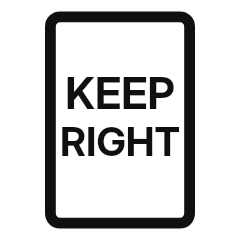
17. A driver ignores this sign and passes on the opposite side. What is the main risk?
Show answer
Answer B: Ending up on the wrong side of a divider, facing traffic coming the other way
The sign settles which side of a fixed divider is the legal one, so taking the other side sends the vehicle into the opposing stream or straight at the obstruction.
-
18. You are at a red light where right turns on red are allowed, you cannot see clearly, and the driver behind sounds the horn. What should you do?
Show answer
Answer C: Stay stopped until you can see that the turn is safe
Turning right on red is permitted, never required, so you wait until you can see that the way is clear no matter what the driver behind does.
-
19. You must slow down in a curve but there is no room to straighten the motorcycle. What should you do?
Show answer
Answer A: Brake gently at first and reduce the lean angle as your speed comes down
Braking and turning compete for the same traction, so brake pressure has to stay light while lean angle is high and can grow as the machine comes upright.
-
20. Why should gloves and jacket sleeves overlap?
Show answer
Answer A: So no gap of bare skin is left at the wrist in a slide or the cold
The wrist is easy to leave exposed, and a gap there lets in cold air and takes the full force of a slide, so gauntlets or elastic cuffs should close the gap.
-
21. Warning signs such as stop ahead, yield ahead and signal ahead are installed mainly where
Show answer
Answer B: the traffic control device cannot be seen from far enough away
These advance warning signs are used when a crest, curve or obstruction keeps the stop sign, yield sign or signal from coming into view in time for a driver to react.
-
22. A friend wants a ride, but their feet do not reach the passenger footrests. What should you do?
Show answer
Answer A: Do not carry them, since they cannot hold a stable position
A passenger who cannot plant both feet on the footrests cannot brace or stay in place, and dangling legs can reach the chain, the exhaust or the wheel.
-
23. A center lane is marked with a broken yellow line on each side and is controlled by overhead lane signals. How is that lane used?
Show answer
Answer A: It carries traffic one way or the other according to the signals
A reversible lane is marked with broken yellow lines on both sides and its direction of travel is set by the lane control signals above it.
-
24. During what period does South Dakota law generally require a vehicle's lamps to be lighted?
Show answer
Answer D: From sunset to sunrise, or any other time visibility is under 200 feet
Lamps must be lit from sunset to sunrise, and also at any other time when a person on the highway cannot be clearly seen from 200 feet away.
-
25. A passenger is getting on at the roadside. Which side should they use if the exhaust and the sidestand allow it?
Show answer
Answer B: The side away from moving traffic, clear of the hot exhaust
Getting on and off away from passing vehicles keeps the passenger out of traffic, and the side chosen must also keep their leg clear of the hot exhaust.