
South Dakota DPS Motorcycle Practice Test 31
- Questions25
- Correct to pass20
- Passing score80%
- Minimum age14 years
-
1. How far forward should a rider sit on the seat?
Show answer
Answer D: Far enough forward that the arms are slightly bent on the grips
Slightly bent arms let the rider steer with the handlebars instead of using the arms to prop up the upper body.
-
2. A load has been packed onto the seat behind you. What else must it not do?
Show answer
Answer A: Restrict how you move on the seat or reach the controls
Baggage that pins the rider in place or gets in the way of the handlebars and levers takes away the control the rider needs in an emergency.
-
3. How should you handle a prescription or over the counter medicine before driving?
Show answer
Answer D: Read the label and ask a pharmacist or doctor whether it affects driving
Many common medicines, including allergy and cold remedies, cause drowsiness or slowed reactions, and the label or a pharmacist can tell you whether driving is safe.
-
4. A vehicle coming toward you has drifted into your lane. What should you do?
Show answer
Answer D: Slow down, sound the horn, flash your lights and steer to the right if possible
Moving right gives the other driver space to recover and keeps you out of the lane they are most likely to return to. Braking reduces the force of any impact.
-
5. Visibility drops suddenly and you decide to leave the highway. What is the safest way to do it?
Show answer
Answer A: Take the next exit or a wide pull off, well clear of the traffic lanes
Get right off the traveled way, and off the shoulder too if you can, because vehicles in poor visibility often drift onto the shoulder.
-
6. A steady red arrow is displayed for your left-turn lane at a two-way intersection. What must you do?
Show answer
Answer C: Stop and remain stopped until an indication permits the turn
A steady red arrow prohibits the movement it points to, so the driver stops and waits for a green arrow, a flashing yellow arrow or another indication that permits the turn.
-
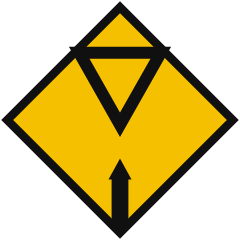
7. What will the driver have to do at the point this sign refers to?
Show answer
Answer C: Slow down and let conflicting traffic go first, stopping if that is what it takes
Further along, the driver has to let conflicting traffic and pedestrians go first, reducing speed and stopping whenever that is necessary to avoid interfering with them.
-
8. Why is passing another vehicle a bad idea in dense fog?
Show answer
Answer C: You cannot see far enough ahead to know the passing lane is clear
A pass needs a clear view of the road well beyond the vehicle you are overtaking, and fog takes exactly that away.
-
9. After a third DUI conviction, a driver caught operating a vehicle during the license revocation period faces what mandatory minimum jail term?
Show answer
Answer B: Ten days
Driving during the revocation that follows a third DUI conviction carries a mandatory, non-suspendable minimum of ten days in jail.
-
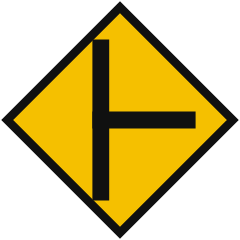
10. What condition does this sign warn a driver about?
Show answer
Answer B: Another road joins the road being traveled, from one side
It announces a side road entering the main roadway, so the driver should expect vehicles waiting to pull out and other vehicles slowing to turn in.
-
11. You are about to pass a bicyclist on a narrow two-lane road. What is the correct way to do it?
Show answer
Answer A: Wait for a clear gap and move well left, giving the rider wide space
Pass a cyclist as you would a car: wait for clear road, change lane position to leave generous clearance, and return only when the rider is well behind you.
-
12. How does alcohol change the time a driver needs to respond to a hazard?
Show answer
Answer A: It slows it, so stopping takes longer
Alcohol is a depressant that lengthens the time between seeing a hazard and acting on it, which adds directly to the distance needed to stop.
-
13. How long should a head check before a lane change last?
Show answer
Answer D: A quick glance, so you do not lose track of what is happening ahead
Traffic ahead can change in a second, so the blind spot check is a fast glance and the rider returns attention to the road immediately.
-
14. A bicyclist ahead of you puts the left arm straight out to the side. What is being signaled?
Show answer
Answer B: A left turn or a move to the left
The left arm held straight out is the bicycle signal for a left turn, so hold back and give the rider room to cross toward the center.
-
15. Another driver takes a right of way that was legally yours. What should you do?
Show answer
Answer A: Give way to the other driver and avoid the crash, whatever the law says
Right of way is something you give, not something you take, and being in the right is no protection in a collision.
-
16. In South Dakota, what must you do when you approach a stopped emergency vehicle that is using red visual signals?
Show answer
Answer D: Come to a complete stop before reaching it and proceed only when it is safe
South Dakota requires drivers coming from any direction to stop completely before reaching a stopped emergency vehicle displaying red lights, then proceed with caution once it is safe.
-
17. It is very hot and a rider is tempted to take off the riding jacket. Why can that make the heat worse?
Show answer
Answer C: A bare arm in hot moving air loses fluid fast and burns in the sun
In hot, dry air a covering layer slows the evaporation of sweat and blocks the sun, so ventilated gear can keep a rider cooler and better hydrated than bare skin.
-
18. You are behind three slow vehicles on a two-lane road and the way ahead looks clear. What is the sound decision?
Show answer
Answer D: Pass one vehicle at a time, if the road allows it
Passing several vehicles in one move keeps you in the oncoming lane far too long and leaves nowhere to go if a vehicle appears.
-
19. What is the first thing to do once your disabled vehicle is stopped on the shoulder?
Show answer
Answer A: Switch on the hazard warning lights so other drivers can see the vehicle
Hazard lights are the fastest way to make a stopped vehicle visible, and everything else can follow once traffic has been warned.
-
20. What is the minimum license revocation period for a second South Dakota DUI conviction?
Show answer
Answer C: One year
A second DUI conviction requires a revocation of at least one year, longer than the 30-day floor used for a first offense.
-
21. You are crossing a divided highway with a wide median. How should you treat the two roadways?
Show answer
Answer D: As two intersections, waiting in the median only when your vehicle fits
Each roadway of a divided highway is a separate intersection, and you should wait in the median only if it is long enough to hold your vehicle clear of both roadways.
-
22. You have a green arrow to turn left. What still applies?
Show answer
Answer D: You must yield to any pedestrian or vehicle still inside the intersection
A green arrow protects your turn from conflicting traffic, but you must still let anyone already in the intersection get clear before you move.
-
23. At an intersection that uses a lagging left turn, when is the left-turn arrow displayed?
Show answer
Answer B: After the through movement has run
A lagging left turn phase runs at the end of the green rather than the start, so a driver waiting to turn should not assume the arrow has been missed.
-
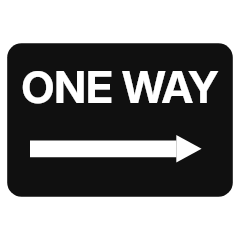
24. A driver disregards this sign and turns so as to travel against the direction it establishes. What is the immediate danger?
Show answer
Answer D: The driver will face traffic head on, because every lane comes the other way
Turning against the established direction puts the vehicle nose to nose with all the traffic on that street, which is why the mistake has to be corrected at once.
-
25. The queue for an exit ramp has backed up into the right lane of the highway. What should you do if you want that exit?
Show answer
Answer B: Join the back of the queue in the lane instead of cutting in later
Passing a queue and forcing in at the front stops the whole line, and using the shoulder puts you where broken-down vehicles are expected to be.