
South Dakota DPS Motorcycle Practice Test 28
- Questions25
- Correct to pass20
- Passing score80%
- Minimum age14 years
-
1. Partway through a ride, a control starts to feel different from the way it normally feels. What is the right response?
Show answer
Answer B: Stop somewhere safe and find out what has changed before riding further
A change in feel is usually the first warning of a failing cable, a leaking brake or a loose fastener, and it is far cheaper to check at the roadside than to discover in traffic.
-
2. A traffic signal is dark and you reach the intersection at the same moment as a vehicle on your right. Who goes first?
Show answer
Answer A: The vehicle on your right, as at any all-way stop
A dark signal is treated as an all-way stop, and the usual tie-breaker then applies: the vehicle on the right goes first.
-
3. Under South Dakota's basic speed law, can a driver be cited for speeding even while traveling at or below the posted limit?
Show answer
Answer A: Yes, if the speed is not reasonable and prudent for the conditions then existing
The law separately requires speeds to be reasonable and prudent for existing conditions, so a driver can violate it even without exceeding the posted number.
-
4. You will leave your vehicle for several hours after dark. Where is the best place to park it?
Show answer
Answer D: In a well-lit spot with people and cameras nearby
Light, passing people and cameras all discourage theft and make your own return to the vehicle safer.
-
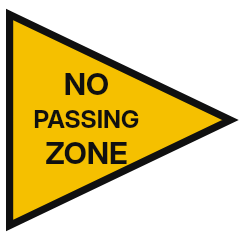
5. Where does the restriction that starts at this sign come to an end?
Show answer
Answer D: Where the centerline markings show that overtaking is allowed again
The sign marks the start of the restricted section, and the centerline markings along the road show how far it runs and where overtaking becomes lawful again.
-
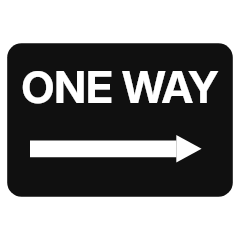
6. A driver on the street this sign governs is preparing to turn left at the next corner. Which lane should the vehicle be in beforehand?
Show answer
Answer A: The lane closest to the left curb
All the traffic here runs the same way, so nothing is coming toward the driver and the turn is taken from the extreme left lane rather than from beside the middle of the roadway.
-
7. When should a rider add a layer on a ride that is turning cold?
Show answer
Answer D: Before you start to feel cold, at the next convenient stop
Once a rider is chilled it takes a long time to warm up again, and cold hands and slowed reactions cost control, so add layers before the cold takes hold.
-
8. How does a wet road change the distance you need to stop?
Show answer
Answer C: It lengthens it, so you need a much bigger gap ahead
Water between the tire and the road cuts grip, so braking distance grows and the gap that works on dry pavement is no longer enough.
-
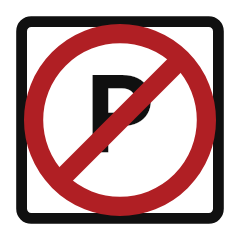
9. A driver leaves the vehicle at the curb where this sign is posted and walks away for two minutes. Is that allowed?
Show answer
Answer B: No, leaving the vehicle unattended there is prohibited whatever the length of the absence
Walking away leaves the vehicle parked, and the prohibition holds regardless of how long the driver is gone or whether the engine is left running.
-
10. A sign warns that your exit leaves from the left side of the freeway. What should you do?
Show answer
Answer D: Move into the left lane in good time before you reach the exit
Left-hand exits are unusual, which is exactly why they are signed well in advance and why the lane changes should be finished early.
-
11. What must a South Dakota driver do before a license suspended under the financial responsibility law can be reinstated?
Show answer
Answer C: Pay the reinstatement fee to the department
The statute requires payment of the reinstatement fee to the department before a financial-responsibility suspension can be lifted.
-
12. Where is the oil and grease strip in a lane usually widest and most slippery?
Show answer
Answer D: At toll plazas, bus stops and intersections where vehicles sit and idle
Oil and coolant drip most where vehicles stop, idle and pull away, so the center strip is widest and slickest at toll booths, bus stops and busy intersections.
-
13. Traffic is backed up just past the exit you want to use at a single-lane roundabout. What should you do?
Show answer
Answer D: Wait at the yield line until you can pass through and exit
You must not enter a roundabout unless you can clear it, because stopping inside blocks every other entry.
-
14. You come up behind a bicyclist who is descending a steep hill in the middle of the traffic lane. What should you take into account?
Show answer
Answer D: The rider may be moving at close to the speed of the traffic
A bicycle can reach the speed of traffic on a descent, so there is little to gain from a pass and the rider needs the whole lane to steer around surface hazards.
-
15. You are circulating in the inner lane of a two-lane roundabout, your exit is next, and a vehicle is beside you in the outer lane. What should you do?
Show answer
Answer C: Keep circulating around the island and take that same exit on your next time around
You may not cut across a vehicle in the outer lane; if you cannot exit safely, continue around the circle and try again.
-
16. You turn from asphalt onto a loose gravel road. What should you do about your speed?
Show answer
Answer D: Lower it, since grip is reduced and stopping takes longer
Loose gravel gives far less grip than pavement, so speed must come down for both steering and stopping.
-
17. A white regulatory sign shows the silhouette of a truck inside a red circle with a diagonal slash. What does it mean?
Show answer
Answer A: Trucks are not allowed to use that road
The circle and slash over a symbol always means the movement or vehicle shown is prohibited, so trucks must keep off that roadway.
-
18. On a narrow two-lane road a line of vehicles has built up behind you. What is the safe and courteous action?
Show answer
Answer D: Pull into a turnout or a safe wide spot and let them go by
A slow vehicle holding up a queue invites risky passing; using a turnout clears the road without anyone having to take a chance.
-
19. The green left-turn arrow ends and a steady red ball comes on for your lane, at an intersection where no turn on red is allowed. What must you do?
Show answer
Answer D: Stop and wait, because no turn is allowed while the red ball is lit
Once a red indication faces your lane and no turn on red is permitted there, the turn is over; only a vehicle already inside the intersection completes its movement.
-
20. Which of these places should never be used to turn your vehicle around?
Show answer
Answer C: The driveway of a fire station or the roadway in front of it
Turning around in or in front of a fire station driveway can block emergency vehicles leaving, and most states prohibit it.
-
21. What is the correct way to secure a load on a motorcycle?
Show answer
Answer C: Fasten it with elastic cords using several attachment points and check it at every stop
Several attachment points hold the load tight so it cannot shift or fall into the wheel or the chain, and checking at stops catches a load that has worked loose.
-
22. You have just merged onto a freeway from an entrance ramp. What should you do next?
Show answer
Answer C: Settle into the right lane and build up speed before changing lanes
Crossing lanes while you are still below the speed of the traffic forces other drivers to brake, so the speed comes first and the lane change second.
-
23. The leader of a group wants to pull the whole group out from a side road into busy traffic. What should the leader do?
Show answer
Answer B: Wait for a gap long enough for every rider in the group to enter
A leader who takes a gap that only fits one machine leaves the rest of the group either stranded or tempted to pull out in front of traffic.
-
24. You are slowing to turn right at an intersection and a bicyclist is riding beside your right side in a bike lane. What should you do?
Show answer
Answer D: Let the bicyclist go through the intersection before you begin the turn
Turning across the path of a bicyclist who is going straight causes the classic right-hook crash. The rider continuing straight has the right-of-way over your turn.
-
25. How long should a rider stay in the oncoming lane while passing?
Show answer
Answer D: Only as long as completing the pass safely requires
Every extra second in the oncoming lane is exposure with no benefit, so the rider passes decisively and returns as soon as the road behind is clear.