
South Dakota DPS Motorcycle Practice Test 22
- Questions25
- Correct to pass20
- Passing score80%
- Minimum age14 years
-
1. The gates at a railroad crossing begin to come down as you approach. What must you do?
Show answer
Answer A: Stop and wait until the gates are fully raised and the lights stop flashing
Once the gates start down you must stop clear of the tracks and wait until they are fully raised and the warning lights have stopped.
-
2. On a long uphill grade a second lane opens on the right and a sign directs slower traffic into it. You are towing a trailer and holding up a line of vehicles. What should you do?
Show answer
Answer A: Move into the right-hand lane and let the faster traffic use the left lane
A climbing lane exists so that slow vehicles can be passed safely, and the slower vehicle is the one that belongs in it.
-
3. If you must abandon a vehicle stuck on the tracks with a train coming, why do you move toward the train and away at an angle?
Show answer
Answer D: Because debris from the impact is thrown forward, away from the train
A train pushes wreckage down the track ahead of it, so walking toward the train and off to the side keeps you out of the debris path.
-
4. A center lane is bordered by a solid yellow line on the outside and a broken yellow line on the inside, with left-turn arrows painted in it. How may you use that lane?
Show answer
Answer A: Only to make a left turn or to prepare for one from either direction
That marking identifies a two-way left turn lane, which may only be used for left turns or to prepare for a left turn and never for travel or passing.
-
5. The driver ahead of you is straddling the lane line and is not signaling. How should you respond?
Show answer
Answer B: Stay back until you can see which lane that driver will take
A vehicle astride the line could move either way, so the only safe place is behind it where both possibilities are still covered.
-
6. A sign at the curb reads Tow-Away Zone. What does it mean for you?
Show answer
Answer C: That a vehicle left there can be removed at the owner's expense
In a tow-away zone the vehicle can be removed immediately and the owner pays the towing and storage charges to get it back.
-
7. A rectangular red sign with the white words WRONG WAY means that
Show answer
Answer C: the driver is already traveling against the legal flow and must not continue
The wrong way sign uses a white legend and border on red and addresses a driver who has entered a ramp or one-way roadway in the wrong direction, who should stop and turn around safely.
-
8. A downpour has just started on a street with a visible dark strip down the middle of the lane. Where should you ride?
Show answer
Answer A: In the left or right portion of the lane, away from the greasy center strip
Dripped oil and grease build up in the center of the lane, and water floats that film to the top, so the tire tracks on either side offer better grip.
-
9. When is a driver or rider most likely to need hand and arm signals instead of the vehicle turn signal lamps?
Show answer
Answer D: When the lamps have failed or cannot be seen because of glare or a load
Hand and arm signals replace or reinforce the lamps whenever the lamps do not work or cannot be seen clearly by other road users.
-
10. A traffic signal is displaying a flashing red light. How must you treat it?
Show answer
Answer D: Stop completely, then proceed when the way is clear
A flashing red carries the same meaning as a stop sign: come to a full stop, then go only when it is safe.
-
11. You are approaching a yield sign on a ramp that joins a busy street. What does the sign require?
Show answer
Answer A: Slow down, be ready to stop, and let the other traffic go first
A yield sign means you must slow, be prepared to stop and give way to traffic on the road you are entering; a full stop is required only when traffic makes it necessary.
-
12. The posted limit is 55 mph, but heavy traffic and rain make that speed unsafe. What does the law expect of you?
Show answer
Answer D: You must slow to a speed that is safe for the conditions
The basic speed rule requires a speed that is reasonable for the traffic, weather and road, and that speed is often well below the posted maximum.
-
13. For an alert driver, about how long is the reaction time once a hazard has been recognized?
Show answer
Answer A: About three quarters of a second
Reaction alone takes roughly three quarters of a second for an alert driver, and perception takes about as long again, so a second and a half of travel is added before the brakes bite.
-
14. Your passenger has ridden on other people's motorcycles before. What should you do before setting off?
Show answer
Answer A: Brief them anyway, because your machine and your instructions differ
Handholds, footrests, exhaust position and the signals a rider uses all vary from machine to machine, so every passenger is briefed on the machine they are about to ride on.
-
15. Once a driver has joined the route this sign begins, how is the rest of the way marked?
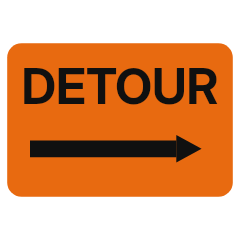
Show answer
Answer B: By further markers of the same kind at each turn, until the original road is rejoined
The alternate route is signed continuously, with a marker at every turn, so a driver with no local knowledge can follow it back to the original road.
-
16. What should the clutch be doing during a quick stop?
Show answer
Answer C: Pulled in as the motorcycle slows, so the engine does not stall
Disengaging the clutch as the machine slows keeps the engine running, so the rider can pull away again immediately if that becomes necessary.
-
17. Besides fitting the machine, what else must a passenger be capable of?
Show answer
Answer B: Following the rider's instructions throughout the ride
Instructions such as staying still, holding on and not getting off until told are what keep the pair balanced, and a passenger who cannot follow them is unsafe.
-
18. How does higher speed affect the outcome of a crash?
Show answer
Answer A: It leaves less time to react and greatly increases the force of impact
Speed shortens the time available to avoid a hazard and raises the energy released in an impact, so both the likelihood and the severity of a crash increase.
-
19. A regulatory sign reads TURN ON HEADLIGHTS NEXT 15 MILES. What does it require?
Show answer
Answer C: Low beam headlights on for that stretch, day or night
Such a section is signed where a road is hard to see along, and the requirement is to run headlights, not just daytime running lamps, through the whole stretch even in bright daylight.
-
20. Why does a passenger often feel the cold sooner than the rider on a long ride?
Show answer
Answer B: A passenger sits still and does not have the fuel tank to shelter behind
The rider has a screen or a tank to break the wind and is busy operating the machine, while a passenger sits exposed and inactive and chills faster.
-
21. On a rural two-lane road you pass small blue signs, each naming one business with an arrow and a distance. What are they?
Show answer
Answer D: Tourist-oriented directional signs for traveler businesses
Tourist-oriented directional signs carry a white legend on blue and are used on rural conventional roads to guide travelers to eligible businesses.
-
22. How often should a rider change position within the lane?
Show answer
Answer C: As often as the traffic, the road surface and the hazards around you change
Lane position is a tool for keeping space and visibility, and both of those change constantly as traffic and road conditions change.
-
23. A large electronic advertising sign beside the road catches your eye. What should you do?
Show answer
Answer A: Glance briefly and return your eyes to the road
Bright changing displays are designed to hold attention, so treat them like any roadside object and give them no more than a brief glance.
-
24. On a long, straight highway you feel your attention fading. What helps you stay alert?
Show answer
Answer A: Keep your eyes moving, scan mirrors and signs, and take regular breaks
Staring at one point brings on highway hypnosis. Active scanning keeps the mind engaged, and a break every couple of hours restores alertness.
-
25. What happens under South Dakota law if a driver violates the move-over or slow-down law and causes an accident with the vehicle involved?
Show answer
Answer B: The offense is elevated to a Class 1 misdemeanor
Causing an accident while violating the slow-down or move-over requirement raises the offense to a Class 1 misdemeanor, a more serious classification than the base violation.