
South Dakota DPS Motorcycle Practice Test 17
- Questions25
- Correct to pass20
- Passing score80%
- Minimum age14 years
-
1. How do the traffic laws apply to riders traveling in a group?
Show answer
Answer D: Every rider is responsible for obeying the law on their own machine
Riding in company changes nothing legally, and each rider answers individually for speed, signals and every other rule of the road.
-
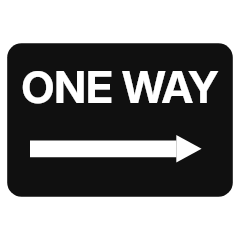
2. Where are signs of this kind placed at an intersection?
Show answer
Answer C: At the near right and far left corners, facing drivers on the intersecting street
They are installed at the corners of the intersecting street so that a driver about to turn in sees the restriction before committing to the turn.
-
3. The overhead signal above your lane changes to a steady yellow X. What should you do?
Show answer
Answer B: Prepare to move out of that lane
A steady yellow X warns that the lane is about to close, so drivers should get ready to vacate it in favor of an open lane.
-
4. You are following a large truck on a two-lane road and cannot see past it. What should you do before deciding to pass?
Show answer
Answer D: Drop back so that your view of the road ahead opens up
Distance is what buys you a view around a large vehicle, and no decision to pass can be made from a position where you cannot see.
-
5. Permanent signs must be retroreflective or lighted so that
Show answer
Answer A: they show the same shape and color at night as by day
Retroreflective sheeting throws headlight light back to the driver, so a sign keeps its daytime shape and color after dark.
-
6. Is it a good idea to shift into neutral and coast down a long hill to save fuel?
Show answer
Answer B: No, you lose engine braking and some control of the vehicle
In neutral the engine cannot help slow the vehicle, so the brakes do all the work and can overheat. Stay in gear so the drivetrain helps hold your speed.
-
7. You are behind a snow plow working on a highway. What is the correct way to drive?
Show answer
Answer C: Stay well back and do not try to pass it
A plow throws snow, runs wider than its body and works on the poor surface ahead of it, so the cleared road behind it is the safest place to be.
-
8. At many crossings the walk indication appears only after a button is pressed. What happens if a pedestrian does not press it?
Show answer
Answer B: The signal may cycle without showing a walk indication
An actuated pedestrian phase is called in by the pushbutton, so without it the controller may serve the vehicle movements alone.
-
9. Why should baggage be kept as low as possible on a motorcycle?
Show answer
Answer C: A high load raises the center of gravity and makes the machine unstable
Weight carried high changes the balance of the motorcycle and makes it feel top heavy in turns and in crosswinds.
-
10. You have shut the engine off with the kill switch because the throttle stuck open. What comes next?
Show answer
Answer D: Keep the clutch in, brake to a stop off the road, and find the cause
With the engine off and the clutch pulled in the motorcycle is only coasting, so brake to a stop clear of traffic and inspect the throttle cable and grip before restarting.
-
11. A pedestrian waiting at a curb faces a steady upraised hand. What does that indication mean?
Show answer
Answer A: Do not start to cross in that direction
A steady upraised hand forbids entering the crosswalk, while a flashing hand only forbids starting a new crossing.
-
12. An emergency vehicle is stopped on the shoulder ahead with its lights flashing. What does the move over principle require?
Show answer
Answer D: Change lanes away from it, or slow down if you cannot
Move over laws ask you to give responders an empty lane, and where traffic or a two-lane road makes that impossible, you slow down instead.
-
13. You approach a traffic signal that has already been green since it first came into view. What should you expect?
Show answer
Answer B: That it may change at any moment, so be ready to stop
A signal already green when you first see it is well into its cycle, so a rider covers the brakes and plans a stop rather than assuming a clear run.
-
14. You turn left onto a road that has a center two-way left-turn lane. In which lane should you be traveling once the turn is finished?
Show answer
Answer D: The first through lane to the right of the center turn lane
The shared center lane is only for turning movements, so even where a state lets you pause in it to merge you must end up in the first ordinary travel lane beside it.
-
15. What is the recommended minimum following distance behind the vehicle ahead?
Show answer
Answer C: Two seconds
A two second gap is the minimum in good conditions and should be stretched to three seconds or more on slippery roads, in poor visibility or in heavy traffic.
-
16. Where should a rider in the middle of a group direct their attention?
Show answer
Answer A: Well ahead through the group and around it, not just at the rider in front
Watching only the machine ahead hides the traffic and hazards further up the road, and it leaves the rider reacting late to everything the group meets.
-
17. A bicyclist stops at a four-way stop just before you do. Who goes first?
Show answer
Answer B: The bicyclist, who reached the intersection and stopped there before you did
A bicyclist on the roadway follows the same right of way rules as a driver, so arrival order decides the turn.
-
18. As a general rule, how far should you travel along a center two-way left-turn lane before you turn?
Show answer
Answer C: Only a short distance, just enough to slow down and wait for a gap
The center lane is for making or preparing a left turn, so you enter it only shortly before the turn and never travel along it as a through lane; several states set a specific limit such as 200 or 300 feet.
-
19. A SHOULDER DROP OFF sign warns that
Show answer
Answer B: there is a step down from the pavement to the shoulder
The sign is used where the edge of the pavement stands several inches above the shoulder, which can grab a wheel and pull the vehicle sideways.
-
20. What makes up the total distance needed to bring a vehicle to a stop?
Show answer
Answer A: The distance covered while you perceive the hazard, the distance covered while you react, and the braking distance
Total stopping distance combines the ground covered while you notice the hazard, the ground covered while you move your foot to the brake, and the ground covered while the brakes slow the vehicle.
-
21. In a work zone the temporary lane lines conflict with the old lines still visible on the pavement. Which do you follow?
Show answer
Answer C: The temporary markings, which show the current traffic pattern
Temporary markings define the traffic pattern in force, and the old lines are simply the layout that no longer applies.
-
22. The lane control signal above your lane changes to a steady yellow X. What should you do?
Show answer
Answer A: Prepare to leave the lane, because it is about to be closed
A steady yellow X is the warning that the lane below it is about to close, giving drivers time to move over before the red X appears.
-
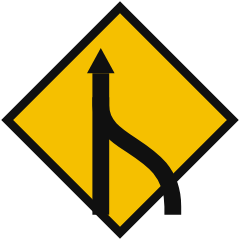
23. What does this sign warn a driver about?
Show answer
Answer A: Traffic from another roadway will enter the same lane ahead
Two traffic streams come together into one lane beyond this point, so drivers on both roadways have to adjust speed and spacing to fit together.
-
24. An arrow panel in a work zone shows four flashing lamps in caution mode instead of an arrow. What does that display mean?
Show answer
Answer A: Warning only, so pass the work area with caution in your current lane
Caution mode gives a general warning without directing a lane change, so drivers stay alert and pass the activity with care.
-
25. You are on an entrance ramp merging onto a freeway. Who has to give way?
Show answer
Answer B: You must yield and fit into a gap in the traffic already on the freeway
Traffic entering a highway must yield to traffic already on it. Use the acceleration lane to match speed and merge into a gap.