
South Dakota DPS Permit Practice Test 45
- Questions25
- Correct to pass20
- Passing score80%
- Minimum age14 years
-
1. You reach an intersection showing a steady red light, and a stop line is painted across your lane. Where must you bring the vehicle to a complete stop?
Show answer
Answer C: Before the stop line
A steady red requires a complete stop before the marked stop line. Where there is no stop line you stop before the crosswalk, and where there is neither, before entering the intersection.
-
2. About how far ahead do low beam headlights let you see on a dark road?
Show answer
Answer B: About 250 feet
Low beams light roughly 250 feet of road, and high beams roughly 350 to 500 feet, which sets the limit on a safe night speed.
-
3. Two solid white lines are painted between your lane and the lane beside it. What do they mean?
Show answer
Answer D: Crossing from one lane to the other is prohibited
Double solid white lines separate lanes of traffic going the same way and may not be crossed.
-
4. The signal turns green as you approach an intersection. What is the safest practice?
Show answer
Answer B: Look left, then right, then left again, and make sure the intersection is clear before entering
A green light gives permission but does not guarantee the intersection is empty, and a quick scan catches a vehicle running the red or a pedestrian still crossing.
-
5. You arrive at an intersection with no signs, no signals and no markings at the same time as a vehicle on the road to your right. What must you do?
Show answer
Answer B: Yield to the vehicle on your right
At an uncontrolled intersection you must yield to a vehicle already in the intersection or approaching from your right.
-
6. Why should a driver crossing several lanes change only one lane at a time?
Show answer
Answer B: Each lane has its own traffic and its own blind spot to be checked
Sweeping across two or three lanes means entering lanes you never checked, so each change gets its own signal, mirror check and head check.
-
7. On a narrow two-lane road a line of vehicles has built up behind you. What is the safe and courteous action?
Show answer
Answer D: Pull into a turnout or a safe wide spot and let them go by
A slow vehicle holding up a queue invites risky passing; using a turnout clears the road without anyone having to take a chance.
-
8. Low sun is shining onto the signal ahead and you cannot tell which light is lit. What should you do?
Show answer
Answer D: Slow down and be ready to stop until you can be sure
An unreadable signal has to be treated as one that may be red, so approach slowly enough to stop while you work out what it shows.
-
9. Under South Dakota's mobile device law, which use of a handheld phone remains lawful while driving?
Show answer
Answer B: Calling 911 or another emergency number to report a crash or hazard
The law exempts using a device to contact 911 or emergency services or to report a fire, accident, hazard, unsafe driver, or crime.
-
10. What must you be sure of before you pull out to pass on a two-lane road?
Show answer
Answer A: That the road ahead is clear far enough for the whole pass
You need enough clear road to pull out, pass and return before any oncoming vehicle arrives, and you must judge that distance before you start.
-
11. An overhead lane-use control signal shows a steady red X above your lane. What does it mean?
Show answer
Answer B: You may not use that lane and must move out of it
A steady red X means the lane below it is closed to you, while a steady yellow X is the warning to prepare to vacate the lane and a downward green arrow means the lane is open.
-
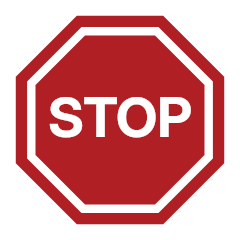
12. A driver slows to walking pace at this sign, never stops rolling and eases into the intersection. How is that treated?
Show answer
Answer B: It is a violation, because the vehicle never came to a complete halt
What is required is a full halt with the wheels no longer turning, so slowing down, however carefully, does not satisfy it.
-
13. In a work zone a flagger signals you to stop, but the sign beside the road says the lane is open. What should you do?
Show answer
Answer C: Obey the flagger
A flagger controls the work zone in real time and the instruction outranks the signs and markings, which cannot reflect what is happening at that moment.
-
14. Why should you set the parking brake even when an automatic transmission is in Park?
Show answer
Answer B: Because it takes the strain off the transmission and holds the vehicle
The parking pawl is a small part carrying the whole vehicle; the parking brake shares that load and holds the vehicle if the pawl fails.
-
15. The driver ahead of you is straddling the lane line and is not signaling. How should you respond?
Show answer
Answer B: Stay back until you can see which lane that driver will take
A vehicle astride the line could move either way, so the only safe place is behind it where both possibilities are still covered.
-
16. You want to move into the right lane just as an entrance ramp joins the highway at that point. What is the better choice?
Show answer
Answer B: Wait until you are past the merge area so you do not squeeze the entering traffic
The merge area is where ramp traffic has to find a gap, so adding a lane change of your own into the same space creates a conflict.
-
17. Which trailer lights must work before you drive away?
Show answer
Answer B: The tail lights, brake lights and turn signals
The trailer hides the vehicle lights from anyone behind, so its own tail, brake and turn signals have to work before you move.
-
18. A vehicle coming toward you has drifted into your lane. What should you do?
Show answer
Answer D: Slow down, sound the horn, flash your lights and steer to the right if possible
Moving right gives the other driver space to recover and keeps you out of the lane they are most likely to return to. Braking reduces the force of any impact.
-
19. A funeral procession with headlights on is crossing an intersection when your light turns green. What should you do?
Show answer
Answer A: Wait and let the whole procession go through
Most states let a funeral procession stay together once the lead vehicle has lawfully entered an intersection, and in every state you must yield to vehicles already in the intersection, so wait until the line has passed.
-
20. What must a South Dakota vehicle operator do with the vehicle's certificate of registration while driving?
Show answer
Answer C: Keep it in possession in the vehicle so a peace officer can inspect it
State law requires the registration to be in the operator's possession while the vehicle is being driven, so a peace officer may inspect it.
-
21. Traffic has built up behind you while you wait for a gap to turn left. How should that affect your decision?
Show answer
Answer C: It should not change it; wait for a gap that is genuinely safe
Pressure from behind does not make a small gap bigger, and rushing a left turn across traffic is a common cause of serious crashes.
-
22. A yellow diamond showing a bicycle is posted on a rural road. What should a driver expect?
Show answer
Answer A: Bicyclists crossing or riding along the roadway there
The bicycle warning sign is used where a bikeway crosses the road or where riders are likely to be in the traffic lanes, so drivers should look carefully and pass wide.
-
23. Why can a motorcycle ahead of you slow down without any warning light showing?
Show answer
Answer B: The rider may slow by downshifting or rolling off
Riders often lose speed by closing the throttle or changing down, which does not switch on the brake light, so watch the machine itself and keep back.
-
24. Your vehicle stalls on railroad tracks and you see a train approaching. What should you do?
Show answer
Answer D: Get everyone out and run toward the train at an angle away from the tracks
Leave the vehicle at once. Running toward the oncoming train and away from the tracks keeps you clear of the wreckage, which is thrown forward in the direction the train is moving.
-
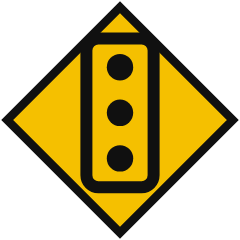
25. A driver passes this sign and the signal beyond it is already showing green. What is the safest response?
Show answer
Answer C: Ease off the accelerator and be ready to stop, because an indication that has been showing for a while is about to change
A signal that has been displaying the same indication for some time is close to changing, so arriving at a controlled speed with the brake covered is safer than accelerating to beat it.