
South Dakota DPS Permit Practice Test 11
- Questions25
- Correct to pass20
- Passing score80%
- Minimum age14 years
-
1. A sign shows a lane joining from the right with no merge required. What does that mean?
Show answer
Answer B: The joining traffic gets its own new lane, so nobody has to merge
An added lane means the roadway gains a lane at that point, so entering vehicles have somewhere to go without anyone changing lanes.
-
2. How many points does eluding a police officer or drag racing add to a South Dakota driving record?
Show answer
Answer B: Six points
Both eluding a police officer and drag racing carry six points on the state's schedule.
-
3. How does higher speed affect the outcome of a crash?
Show answer
Answer A: It leaves less time to react and greatly increases the force of impact
Speed shortens the time available to avoid a hazard and raises the energy released in an impact, so both the likelihood and the severity of a crash increase.
-
4. You have begun to move into the next lane when the gap you were aiming for closes. What is the safest action?
Show answer
Answer C: Return to your own lane, cancel the signal and wait for a better gap
An unfinished lane change leaves you in a space that no longer exists, and the lane you came from is still yours.
-
5. In slow summer traffic the temperature gauge climbs into the red. What should you do first?
Show answer
Answer A: Turn off the air conditioner and turn on the heater to draw heat from the engine
The heater core acts as an extra radiator, and shutting off the air conditioner reduces engine load. If the gauge keeps climbing, pull over and shut off the engine, and never open a hot radiator cap.
-
6. What does this sign tell a driver about the road ahead?
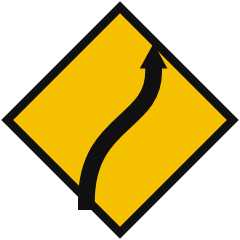
Show answer
Answer A: The roadway changes direction ahead, so speed should be reduced before reaching it
It gives advance notice of a change in alignment so the driver can slow down before entering, since braking inside a bend uses up grip that is needed for steering.
-
7. When should you move into the lane you need for a turn?
Show answer
Answer D: Well before the intersection, as soon as you know your route
Getting into the correct lane early lets other drivers read your intentions and keeps you from making a sudden lane change at the corner.
-
8. A pedestrian signal changes to a flashing upraised hand. What does that indication mean?
Show answer
Answer C: Do not start crossing, but finish a crossing already begun
The flashing upraised hand is the pedestrian change interval: nobody may start to cross, but a pedestrian already in the crosswalk may continue to the far side or to a median.
-
9. How must a South Dakota law enforcement officer enforce the wireless communication device ban that applies to instruction permit and restricted minor's permit holders?
Show answer
Answer A: As a secondary action, only after the vehicle has already been stopped for another reason
State law requires this violation to be enforced as a secondary action, meaning an officer cannot stop the permit holder for that violation alone.
-
10. You are waiting to enter a two-lane roundabout and traffic is circulating in both lanes. What must you do?
Show answer
Answer A: Yield to traffic in both circulating lanes before you enter
Every entry to a roundabout is a yield point, and at a two-lane roundabout that means giving way to vehicles in either circulating lane.
-
11. A sign on a long descent points to a RUNAWAY TRUCK RAMP a mile ahead. What is that ramp for?
Show answer
Answer C: Stopping a vehicle whose brakes have failed
An escape ramp climbs into deep gravel or sand to bring a vehicle with failed brakes to a halt, so no one should stop or park in it.
-
12. You will leave your vehicle for several hours after dark. Where is the best place to park it?
Show answer
Answer D: In a well-lit spot with people and cameras nearby
Light, passing people and cameras all discourage theft and make your own return to the vehicle safer.
-
13. A set of reversible express lanes is closed off with gates and signs while it runs the other way. What must you never do?
Show answer
Answer C: Enter past a closed gate or a sign showing the lanes are closed
When reversible lanes are closed they may already be carrying traffic in the opposite direction, so entering past a gate can put you head-on into that traffic.
-
14. An emergency vehicle is stopped on the shoulder ahead with its lights flashing. What does the move over principle require?
Show answer
Answer D: Change lanes away from it, or slow down if you cannot
Move over laws ask you to give responders an empty lane, and where traffic or a two-lane road makes that impossible, you slow down instead.
-
15. Your power steering fails while you are driving. What happens and what should you do?
Show answer
Answer B: Steering becomes much harder but still works, so slow down and pull off the road
Without power assistance the steering still works, but it takes much more effort, especially at low speed. Keep both hands on the wheel and get off the road.
-
16. Why are drivers required to turn the front wheels when parking on a grade?
Show answer
Answer A: So that a vehicle that starts to roll leaves the traffic lanes instead of entering them
The wheel position is a last line of defense if the parking brake or transmission fails, directing the vehicle into the curb or off the roadway.
-
17. A pedestrian using a white cane or walking with a guide dog starts to cross the street ahead of you. What must you do?
Show answer
Answer A: Yield and stay stopped until the person has finished crossing
A white cane or guide dog identifies a pedestrian who may not be able to see your vehicle, so you must yield and wait rather than maneuver around the person. The horn can confuse the pedestrian or the dog.
-
18. A yellow diamond shows the two edges of the road pinching toward each other. What does it mean?
Show answer
Answer B: The pavement gets narrower but the lanes continue
The road narrows sign warns that the traveled way becomes tighter, leaving less room beside passing vehicles even though no lane is dropped.
-
19. You have just returned to your own lane after passing. Why should you not slow down straight away?
Show answer
Answer A: The vehicle you passed is close behind and needs room to stop
Returning and then braking leaves the driver you just overtook with almost no following distance, which is how a pass turns into a rear-end collision.
-
20. A large X with the letters R and R beside it is painted across your lane. What does it mean?
Show answer
Answer A: A railroad crossing lies a short distance ahead
The pavement marking repeats the advance warning for a grade crossing, and it is used on paved approaches where speeds are high or where gates are installed.
-
21. You are in the right-hand lane of a multilane street and that lane becomes a right-turn-only lane ahead, but you want to go straight. What should you do?
Show answer
Answer B: Change into a through lane before you reach the markings for the turn lane
A lane-use arrow is a regulatory marking, so a driver who wants to continue straight has to leave that lane before it becomes a mandatory turn lane.
-
22. At 45 mph you look at a navigation screen for four seconds. Roughly how far do you travel unseeing?
Show answer
Answer D: About 260 feet
At 45 mph you cover roughly 66 feet a second, so four seconds on a screen is around 260 feet of road that you never looked at.
-
23. You are in the middle lane of a one-way street with three lanes when a police car approaches from behind with lights and siren. What should you do?
Show answer
Answer C: Pull to the nearest curb and stop clear of the lanes
On a one-way street you clear to whichever curb is closest, so the emergency vehicle gets a clear path down the open lanes.
-
24. What happens to your field of vision as your speed increases?
Show answer
Answer C: It narrows, so you notice less at the sides of the road
The faster you travel, the more your useful field of view narrows toward the center, so a hazard coming from the side is seen late or missed altogether.
-
25. During what period does South Dakota law generally require a vehicle's lamps to be lighted?
Show answer
Answer D: From sunset to sunrise, or any other time visibility is under 200 feet
Lamps must be lit from sunset to sunrise, and also at any other time when a person on the highway cannot be clearly seen from 200 feet away.